The Chartered Institute of Personnel and Development (CIPD) is a highly reputable HR and Learning and Development professional body. CIPD qualifications can help develop the skills and knowledge to succeed, whether you are just beginning your HR career or in a role that requires leadership and management.
But, there are numerous students who tend to get confused regarding the distinctions between assignments for CIPD level 3, level 5 and level 7. All three qualifications are based on HR and people management but have differing levels of difficulty, expectations and academic rigour.
This guide will delve into the distinctions between the assignments of the CIPD Level 3, 5 and 7 training courses to get a clearer idea of what is expected at each level.
Learning about the CIPD Qualification Levels
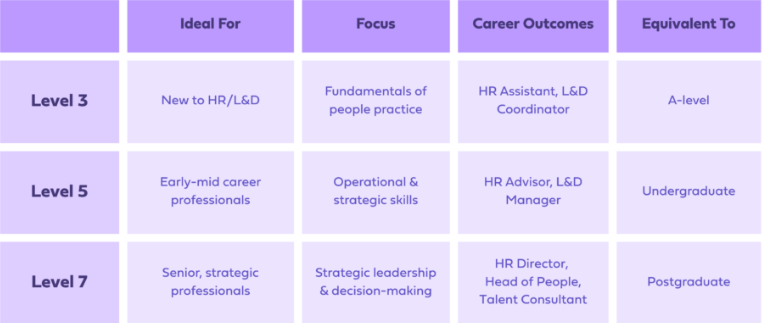
It's important to understand the level of each CIPD qualification before comparing assignments.
CIPD Level 3
Level 3 is considered the foundation level. It is perfect for beginners, entry-level HR professionals or those new to the people management field.
CIPD Level 5
Level 5 is an intermediate-level qualification, suitable for people who already have some HR experience and wish to progress to management or advisory positions.
CIPD Level 7
Level 7 is a higher-level qualification (postgraduate). It's designed for HR professionals with experience who are looking for leadership roles.
The level of research, critical thinking and analysis required grows progressively as students progress from Level 3 to Level 7.
The Complexity of Assignments
The major differences among the three levels are the difficulty of the assignments.
Level 3 Assignments
At level 3, assignments are based on developing an understanding of basic HR concepts. Generally, the student will be asked to explain theories, define terms and show basic knowledge.
Examples include:
-
Recruitment and selection processes.
-
The rights of an employee and their responsibilities.
-
Basic employment law
-
Workplace communication
Questions tend to be factual and based on knowledge and understanding.
Level 5 Assignments
Students need to extend what they have learned beyond explanation in Level 5 assignments. They have to analyze situations, evaluate practices, and apply HR theories to real workplace situations.
Examples include:
-
Talent management strategies
-
Employee engagement initiatives
-
Performance management systems
-
Organizational development
It is expected that students will give practical recommendations and provide evidence to support their recommendations.
Level 7 Assignments
Level 7 assignments are strategic and very high level. The students should critically analyze HR practices, evaluate organizational issues and propose solutions that are consistent with the business goals.
Topics often include:
-
Strategic workforce planning
-
Organizational transformation
-
The effectiveness of leadership and change management
-
Global people management
Such tasks require postgraduate level thinking and professional judgment.
Research Requirements
Research is a critical part of CIPD assignments and the amount of research will vary from qualification to qualification.
Research in Level 3
At Level 3 students primarily access CIPD resources, textbooks and basic academic resources. Emphasis is placed on the understanding and accurate description of concepts.
Research in Level 5
Students should draw on a wider variety of sources at Level 5 such as academic journals, industry reports and case studies. The importance of evidence-based practice increases.
Research in Level 7
At level 7, students are expected to do a lot of academic research. Students are required to read peer-reviewed journals, strategic HR models and industry news. The ability to provide well-reasoned and critical references is critical.
Critical Thinking Expectations
Another significant distinction is the amount of critical thinking that is needed.
Level 3
Pupils predominantly explain and describe concepts. There is a lack of critical analysis.
For example:
"What's the definition of employee engagement?"
The student just describes the concept and its significance.
Level 5
Students are required to analyse and contrast various methods and their success.
For example:
"Assess how employee engagement initiatives relate to organisational performance."
This calls for more analysis and arguments based on evidence.
Level 7
Theories should be critically assessed, assumptions challenged and strategic recommendations developed.
For example:
"Evaluate employee engagement models and how they are effective in the context of multinationals."
There is no right or wrong answer at this point. Students will be expected to make independent judgments based on research.
Word Count Policy
The word count differs for each level of CIPD.
CIPD Level 3
The word count limit is set at 3000 words +/- 10%
CIPD Level 5
The word count limit is set at 5000 words +/- 10%
CIPD Level 7
The word count limit is set at 7000 words +/- 10%
You can also hire expert Assignment Help to guide you about the CIPD word count policy.
Academic Writing Standards
Expectations in terms of quality of writing also rise from level to level.
Level 3 Writing
Writing style must be clear, organised and easy to comprehend. Requires basic referencing skills.
Level 5 Writing
Student academic writing abilities, such as analysis, evaluation, and evidence-based arguments, should be improved.
Level 7 Writing
At level 7, assignments should be written in a professional academic style, use a high level of referencing and many well-structured arguments. The student should be able to present complex ideas clearly and persuasively.
Students can also hire the CIPD Assignment Writing Service to assist them out.
Workplace Application
As students advance to the higher levels, their application of knowledge becomes more and more significant.
Level 3
Assignments are based on HR processes and procedures.
Level 5
Students use HR theories in the workplace and give practical suggestions.
Level 7
Assignments must be strategically thought out and fit with the bigger picture of the organization. Real business problems are frequently examined and solutions are provided that may help organisations be successful.
Assessment Criteria
The expectations are different for each of the assignments set by the CIPD but the learning outcomes are used as the basis for assessment.
Level 3 Assessment
Tutors look for:
-
Accurate knowledge
-
Understanding of concepts
-
Clear explanations
-
Basic referencing
Level 5 Assessment
Tutors assess:
-
Application of theory
-
Analytical skills
-
Problem-solving ability
-
Evidence-based recommendations
Level 7 Assessment
Tutors focus on:
-
Strategic thinking
-
Critical evaluation
-
Original insights
-
Advanced academic research
The higher the level, the more independent thinking and professional judgment is emphasized.
Conclusion
Understanding the differences between CIPD Level 3, 5, and 7 assignments can help students prepare more effectively and meet academic expectations. While Level 3 focuses on foundational knowledge, Level 5 emphasizes analysis and practical application. Level 7, on the other hand, requires strategic thinking, advanced research, and critical evaluation.
As you progress through the CIPD qualification framework, the demands of assignments become increasingly challenging. By understanding what tutors expect at each level, you can develop the skills necessary to produce high-quality work and achieve academic success. Whether you are just beginning your CIPD journey or advancing toward strategic leadership, recognizing these key differences will help you approach your assignments with confidence.